
Cream Charger OEM: Customization Options, MOQ, Costs, and How the Process Works
2026-09-16
Cream charger OEM is the process of having a specialized factory produce N2O cream chargers and cylinders under your own brand, with your choice of capacity, flavor, cylinder finish, logo, and packaging. For distributors, private label brands, and foodservice chains, it is the standard route from reselling other brands to owning a product line with defensible margins.
This guide covers the questions buyers ask before their first OEM order: what OEM actually means versus ODM and white label, which product variables are open for customization, how the process runs from inquiry to delivery, what it costs, what MOQ and lead time to expect, and how to verify that a supplier is a real manufacturer with certified production.
What Does Cream Charger OEM Mean?
OEM stands for Original Equipment Manufacturer. In the cream charger industry, an OEM arrangement means a factory with its own cylinder production and gas filling lines manufactures chargers to your specification, and the finished product carries your brand. The factory supplies the production capability; you own the brand, the pricing, and the customer relationship.
Buyers often meet four related terms when sourcing. They describe different levels of customization and involvement, and confusing them leads to mismatched quotes:
| Model | Who designs the product | Customization depth | Typical commitment | Best for |
|---|---|---|---|---|
| OEM | Factory platform, buyer's spec and brand | Capacity, flavor, color, finish, logo, packaging | Moderate MOQ, mid-range unit cost | Brands building a differentiated product line |
| ODM | Factory designs from buyer's concept | New product engineering beyond existing platforms | Higher MOQ, development cost, longer timeline | Buyers needing a product that does not exist yet |
| Private label | Factory's standard product | Branding and packaging only | Lower MOQ, fast turnaround | Retailers and distributors entering the category |
| White label | Factory's generic product sold to many buyers | Label only | Lowest MOQ | Testing a market with minimal investment |
Most cream charger orders described as OEM sit between private label and ODM: the product platform already exists, and the buyer customizes every visible and commercial variable on it. Established factories typically offer the full range, from white label supply to complete OEM brand development, so buyers can start with simple branding and deepen customization as volume grows.
What Can You Customize in a Cream Charger OEM Order?
On a mature production line, nearly every variable a customer can see or touch is open for customization. The table below reflects the actual option ranges available from an integrated cream charger factory:
| Dimension | Available options |
|---|---|
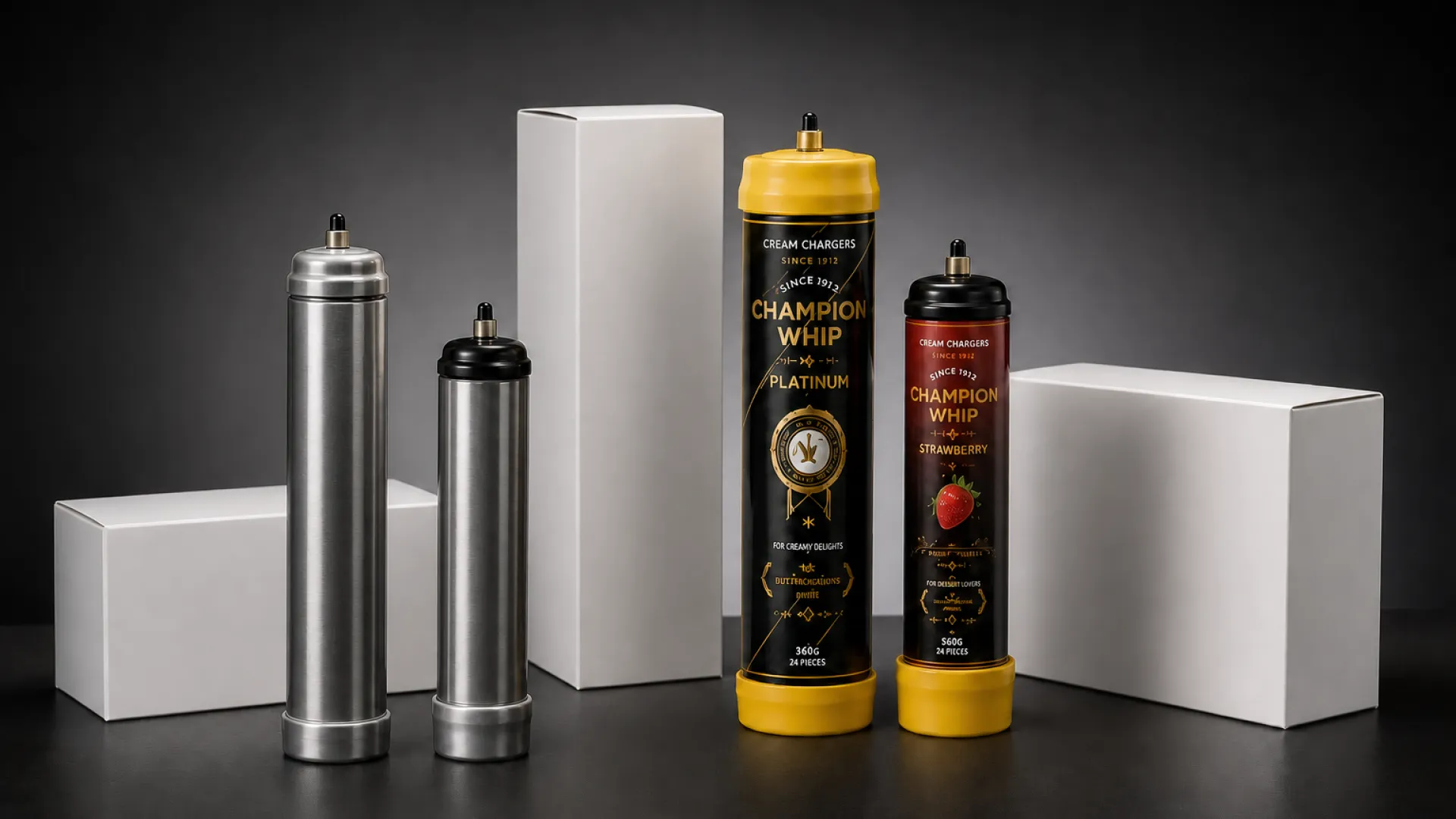
| Capacity | 8g cartridges; N2O cylinders in 320g, 580g, 615g, 640g, 700g, 1364g, 1650g, 2000g, 3000g, 3750g |
| Flavor | Original; blueberry, pineapple, strawberry, watermelon; custom flavor development and mixed flavor combos |
| Gas purity | 99.9% or 99.95% food-grade N2O |
| Cylinder color | Standard silver, black, gold, white, or any PANTONE-matched custom color |
| Finish | Glossy, matte, spray coating, electroplating |
| Logo application | Laser engraving on 8g cartridges; UV printing on cylinders; wrap-around labels on cylinders |
| Safety valve | Standard valve or safety valve on cylinder lines |
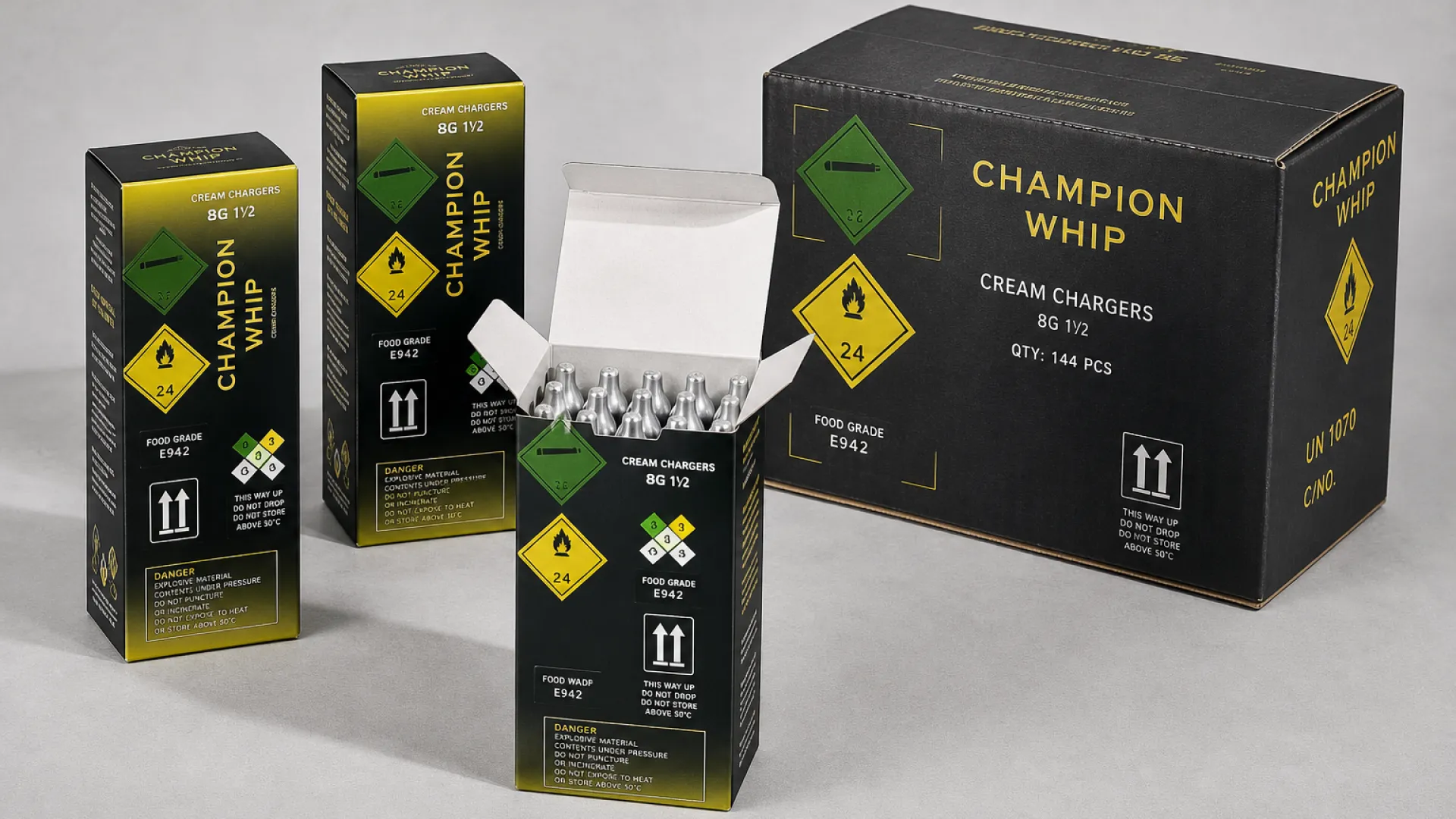
| Inner packaging | 10, 24, or 50 count layouts for 8g; single box or multi-pack trays for cylinders; custom layouts |
| Outer packaging | Standard, full-color printed, window box, or custom-structure colorbox; branded master cartons |
| Documentation | FDA, CE, FSSC22000, SGS certificates and market-specific compliance documents |
Two details are worth understanding before you brief a factory. First, the logo method depends on the product format. Laser engraving etches the design permanently into the steel of 8g cartridges; it survives handling and stacking, but renders in a single tone. UV printing applies full-color artwork to large cylinders and suits complex brand designs, while wrap-around labels work when the artwork changes frequently across SKUs. Second, color is specified against the PANTONE standard, so the cylinder, cap, base, and packaging of every batch match the brand's visual identity exactly.
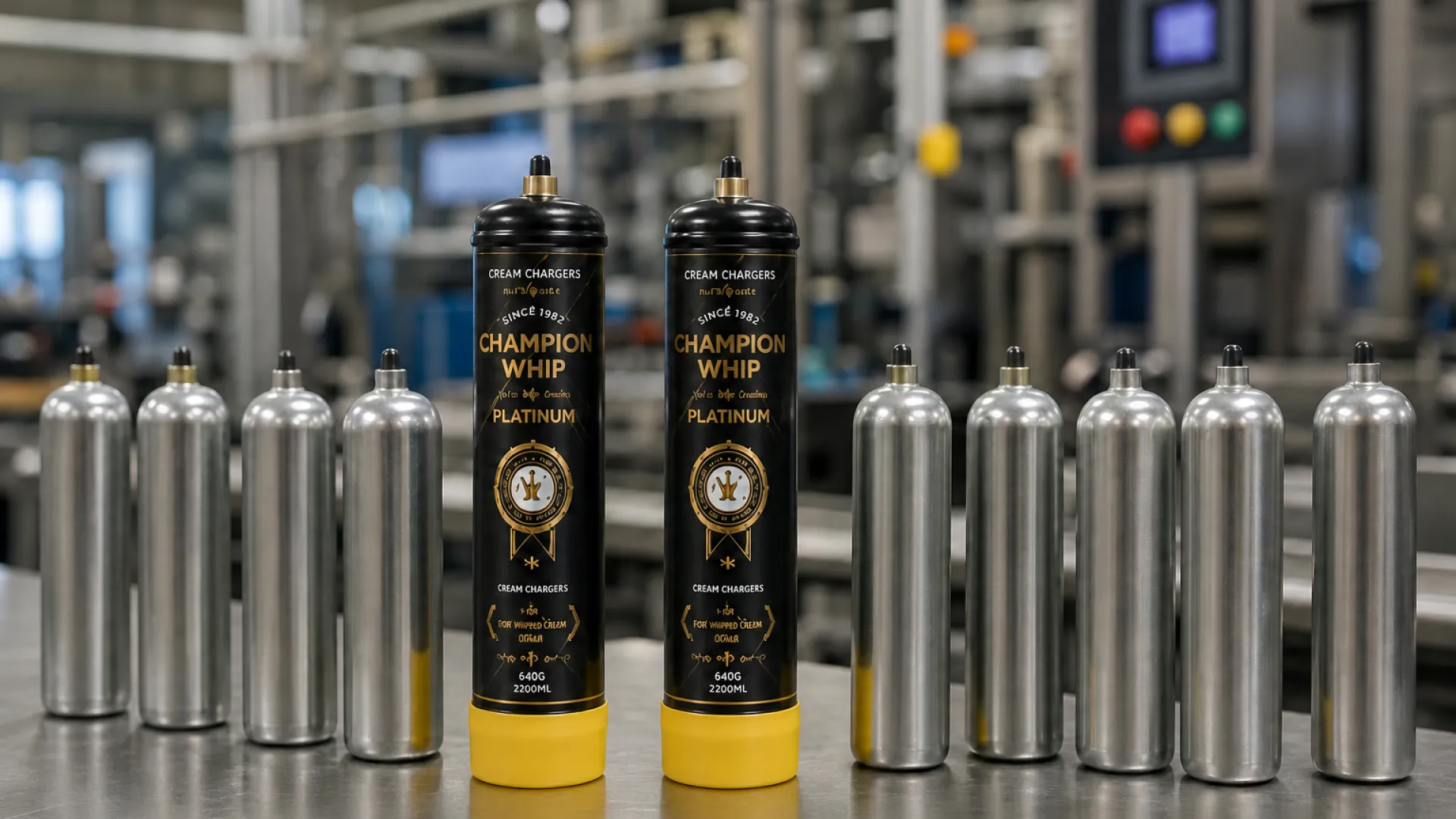
Flavor customization goes beyond picking from a catalog. Factories with their own gas filling lines can develop custom flavor profiles or fill mixed flavor combos within one order, which lets a brand test several variants without committing full production volume to each. Our flavored N2O cylinders show how a flavored line typically reaches the market.
How Does the Cream Charger OEM Process Work?
The OEM process follows six stages from first contact to repeat orders. Knowing the sequence helps you plan a launch date backwards from the selling season:
- Specification consultation. You define capacity, flavor, purity, cylinder finish, logo method, packaging format, and target markets. The factory confirms feasibility and certification coverage for your destination market.
- Quotation. You receive pricing by quantity tier, with customization costs itemized. Responsive factories return a complete quotation within 24 to 48 hours.
- Sampling and approval. The factory produces samples with your branding and specifications. You verify gas purity, fill weight, finish quality, and packaging before authorizing production.
- Mass production. Cylinder manufacturing, gas filling, printing, and packing run on coordinated lines. Production of a custom order typically takes 25 to 35 days depending on customization scope.
- Quality testing and documentation. Batches are tested for purity, leakage, and fill consistency. The factory issues certificates and compliance documents for your market.
- Export packing and shipping. N2O products are classified as dangerous goods (UN 1070, Class 2.2) and travel in DG containers with the required declarations. Sea freight to North America or Europe typically adds three to six weeks.
Two points in this sequence deserve attention. Sampling is the cheapest quality gate in the entire process: a buyer who approves samples against a written specification rarely disputes mass production. And because cream chargers ship as dangerous goods, freight booking requires a supplier experienced with DG documentation; factories that fill and export in volume handle this as routine.
How Much Does Cream Charger OEM Cost?
OEM pricing is built from five components, and understanding each one prevents surprises when the invoice arrives:
- Base unit price. The product itself, quoted on a sliding scale by quantity. Larger volumes pull the unit price down, which is why OEM economics improve with every reorder.
- Customization. Laser engraving adds little per unit. PANTONE color matching, electroplating, and custom flavor development add more, because they alter the production setup itself.
- Packaging. Standard cartons cost the least. Full-color printed boxes, window boxes, and custom structures add cost per unit but also shelf value.
- Documentation. Standard certification packages are normally included; market-specific testing or registration is quoted separately.
- Freight and duties. DG-rated sea freight, insurance, and import duties in the destination market. These often equal or exceed the customization cost, so landed cost is the only honest comparison between suppliers.
As a rule of thumb, OEM becomes the better economics once your brand can price above generic products by a margin larger than the combined customization, packaging, and inventory cost of the MOQ. Buyers still testing demand usually start with bulk cream chargers from stock lines, then switch to OEM once monthly volume justifies a committed production run.
What MOQ and Lead Time Should You Expect?
MOQ in this industry is counted in pallets. Reference points from a factory's standard OEM terms: 8g cartridge OEM orders start at 2 pallets, and N2O cylinder orders at 10 pallets across all SKUs, with production lead times of 25 to 35 days depending on customization scope. Listings on major B2B platforms show comparable figures, with pallet-quantity orders quoted at around 25 days of production time.
For a first OEM order, the practical approach is to commit one SKU at the minimum quantity, sell it through, and reorder at scale. This caps inventory risk while giving you real sell-through data. Buyers who start with three flavors and custom boxes at high volume often spend a year working down stock of the variant that moved slowest.
OEM vs Stock Wholesale: Which Fits Your Business?
OEM and stock wholesale solve different problems. The comparison below maps the trade-offs:
| Factor | OEM customization | Stock wholesale |
|---|---|---|
| Brand | Your brand, your pricing power | Factory or third-party brand |
| MOQ | Pallet-level commitment per SKU | Lower entry quantities |
| Lead time | 25 to 35 days production plus freight | Ships from available stock |
| Unit economics | Higher margin potential at scale | Margin set by brand owner |
| Best for | Distributors and brands building long-term lines | New entrants and demand testing |
Many buyers run both in sequence: stock wholesale to validate a market, OEM to own it. The switch point comes when monthly offtake can absorb a production run within a reasonable sales cycle.
How to Evaluate a Cream Charger OEM Supplier
The supplier you choose determines product safety, brand reputation, and supply continuity. Six checks separate real manufacturers from intermediaries:
- Verify certifications directly. Serious factories hold FDA registration, CE, FSSC22000, and SGS test reports. Ask for report numbers and verify them with the issuing body, since certificates are frequently borrowed in this trade.
- Ask where the cylinder and the gas come from. A factory that manufactures cylinders and fills N2O under one roof controls purity, fill weight, and lead time at every step. Traders who outsource filling cannot make that guarantee, and quality disputes between subcontractors tend to land on the buyer.
- Test samples against a written specification. Check the certificate of analysis for 99.95% food-grade purity, weigh filled units for consistency, inspect for oil residue, and test for leaks. A factory confident in its line welcomes this scrutiny.
- Confirm customization capability in detail. Which printing method, which color standard, which packaging structures, and what proofing process before production. Vague answers here predict disputes later.
- Review export documentation practice. COA, MSDS, and DG shipping declarations should be routine paperwork, not special requests.
- Measure communication before you pay. Quotation speed, technical fluency, and willingness to put terms in writing during the inquiry stage predict how the supplier behaves after the deposit.
Champion Whip operates integrated cylinder manufacturing and N2O filling lines with FDA, CE, FSSC22000, and SGS certified production, OEM orders from 2 pallets on 8g cartridges and 10 pallets on cylinders, and 25 to 35 day lead times. If you are planning a custom line, our team can walk your specifications through our cream charger OEM service and return a quotation with sampling options.
FAQ
What is an OEM cream charger?
An OEM cream charger is an N2O charger or cylinder produced by a specialized factory to a buyer's specification and sold under the buyer's own brand. The factory handles cylinder manufacturing, gas filling, printing, and packing, while the buyer owns the brand, pricing, and customer relationship.
What is the difference between OEM and ODM cream chargers?
OEM means the factory customizes its existing product platform for your brand, covering capacity, flavor, color, finish, logo, and packaging. ODM goes further: the factory engineers a new product from your concept, which involves development cost, higher MOQ, and a longer timeline. Most cream charger buyers need OEM, since the product platforms are already mature.
What is the typical MOQ for custom cream chargers?
MOQ is counted in pallets. Reference figures from a factory's standard OEM terms: 8g cartridge orders start at 2 pallets and N2O cylinder orders at 10 pallets, with 25 to 35 day production lead times depending on customization scope.
How long does OEM production and shipping take?
Production of a custom order typically takes 25 to 35 days after sample approval. Cream chargers ship as dangerous goods (UN 1070, Class 2.2) in DG containers, and sea freight to North America or Europe adds roughly three to six weeks. Plan eight to ten weeks from order confirmation to warehouse receipt.
Can I customize the flavor of N2O in an OEM order?
Yes. Factories with their own gas filling lines offer flavored N2O lines such as blueberry, pineapple, strawberry, and watermelon, and can develop custom flavor profiles or fill mixed flavor combos within one order. This lets a brand test several variants without committing full volume to each.
What certifications should an OEM cream charger factory have?
Look for FDA registration, CE marking, FSSC22000 food safety certification, and SGS test reports covering 99.95% food-grade N2O purity. Ask for report numbers and verify them with the issuing body, and request a certificate of analysis with every shipment.
Are cream chargers legal to buy in bulk for commercial use and resale?
Food-grade N2O cream chargers are a legitimate culinary product sold worldwide for whipping cream and making foams, and bulk commercial purchase is standard practice. Regulations differ by market, particularly around retail sale and minimum age, so distributors should confirm local rules in their destination markets before importing. A qualified OEM supplier provides the compliance documentation required for legal import and sale.

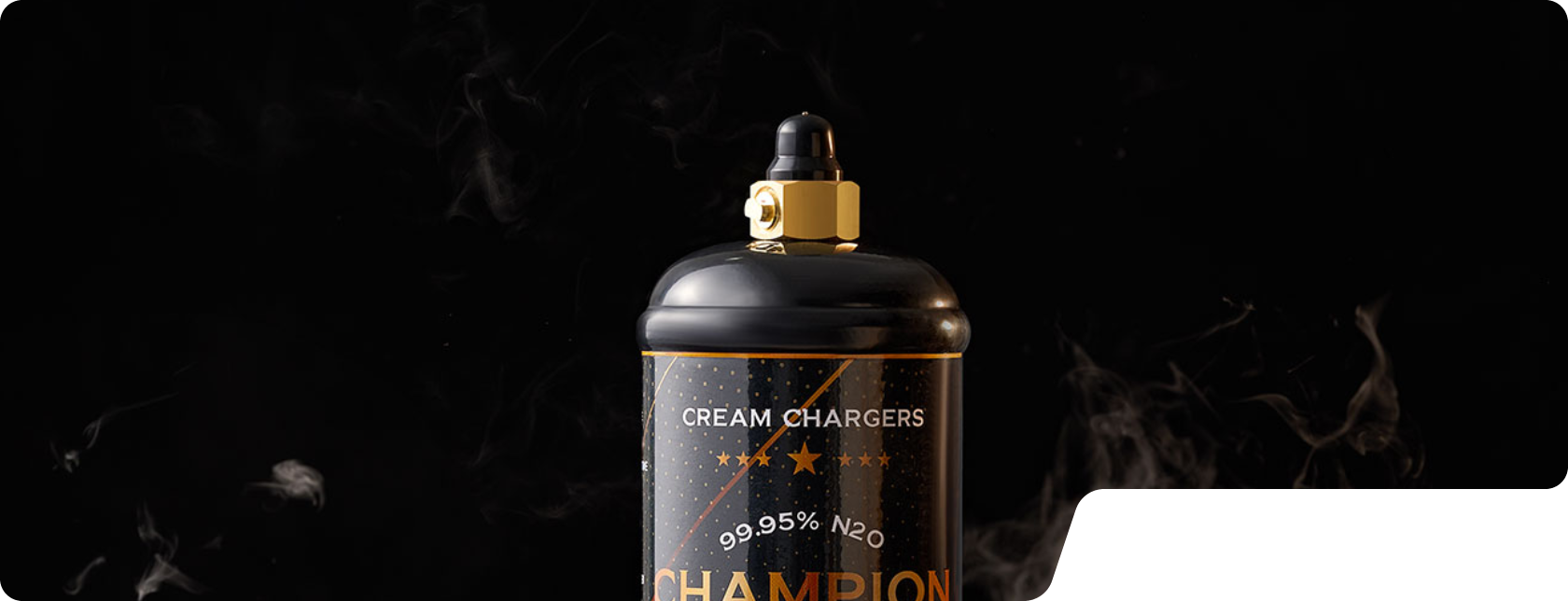
Elevate Your Creations with
Champion Whip
Explore our premium whipped cream chargers – designed for perfectionists.
View our Products


